
Standard review candidate
The available context appears suitable for the normal analysis workflow.
Start with the contract context—not a document checklist. We first determine whether the situation appears worth reviewing, then request only the records needed to verify the adjustment and calculate the supported cost impact.

The process is designed around records your team already uses: contract documents, wage determinations, payroll or labor reports, and supporting cost records where needed.
You do not need to replace your payroll provider, accounting system, ERP, or contract-management process.
Each stage narrows what is needed next. Missing or uncertain information is identified rather than assumed.
The initial check asks for basic information about the contract, what changed, the approximate workforce affected, and where you are in the adjustment process.
You do not need to locate the wage determination, payroll files, or supporting cost records before checking a contract.
The purpose of this step is simply to determine what kind of review may be appropriate and what information, if any, should be requested next.
If you contact our review team, we examine the contract context with you to determine whether the situation appears suitable for the standard recovery-analysis process, whether a small amount of additional context is needed, or whether the facts require more specialized review.
The available context appears suitable for the normal analysis workflow.
A limited question or record is needed before the scope can be confirmed.
The situation may involve factors such as CBA or Section 4(c) considerations where applicable, unusual contract terms, disputed applicability, or other issues that require additional scoping.
If a full analysis makes sense, we confirm the scope and fee before beginning the detailed review.
Once the scope is confirmed, we'll tell you which records are needed for the analysis. The request depends on the contract and adjustment event rather than a one-size-fits-all document checklist.
Contract, relevant modification or option documentation, and other documents needed to establish the event being reviewed.
The wage determination or related material needed to establish the applicable wage and fringe requirements.
The records needed to identify affected employees, actual rates, and supported covered hours.
Requested only where relevant—for example fringe support or information needed to substantiate qualifying employer-cost effects.
If a record is missing or uncertain, we identify the gap. We do not substitute an unsupported assumption.
If the analysis proceeds, we'll provide a separate secure method for submitting the necessary records.
The analysis brings the contract event, applicable wage determination, workforce records, and relevant cost support together to establish the facts used in the calculation.
Information that cannot be supported by the available records is flagged for clarification or excluded from the supported amount rather than treated as certain.
Once the required facts are established, the supported cost impact is calculated using the verified contract, wage, fringe, payroll, hours, and applicable employer-cost inputs.
The calculation is based on the supported records behind the case—not a generalized multiplier or generated estimate.
The components that apply depend on the specific contract, facts, and available evidence.
The final analysis is designed to make the result reviewable rather than giving you only a number.
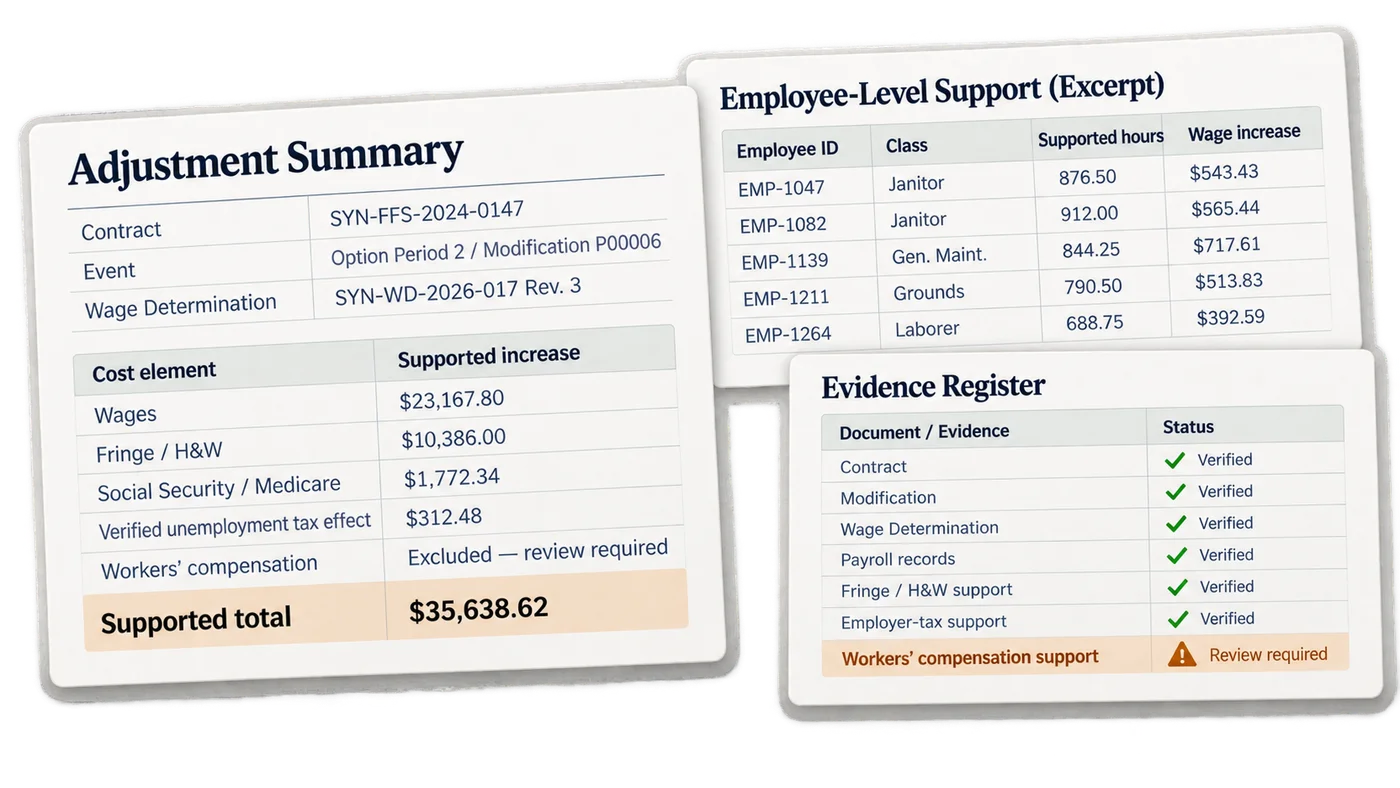
Illustrative synthetic example. Not a real contractor, contract, wage determination, claim, Government decision, or recovery result.
A documented calculation showing the supported cost impact.
Where applicable, the underlying employee, rate, hour, and cost detail used to support the calculation.
A connection between material calculation inputs and the records behind them.
Any missing evidence, unresolved issue, or item requiring additional review is identified.
The documented calculation and supporting materials can then be used for internal review and preparation of your price-adjustment request.
The initial service is focused on identifying, calculating, documenting, and supporting the adjustment analysis.
It does not automatically submit a request to the Government, represent the contractor before the contracting officer, or guarantee acceptance or payment.
If the contracting officer requests clarification or additional support, the existing analysis provides a structured record of how the amount was developed and what evidence supports it.

A reliable adjustment analysis requires more than comparing two wage determinations. But that does not mean a contractor should have to assemble every possible document before knowing whether the contract is worth reviewing.
The process separates preliminary screening from evidence verification so that each stage asks only for the information necessary to make the next decision.
Basic contract and event context.
Only the records needed for the particular case.
Unsupported information is not quietly converted into a calculation input.
No. The initial check can be completed with the information you already know.
No. The analysis works from appropriate exports and existing supporting records.
No. Applicability and the supportable amount depend on the contract, applicable requirements, facts, and evidence. Contracting-officer acceptance or Government payment is not guaranteed.
Evaluate your contract context in seconds. If the situation warrants review, we'll explain what records are needed next.
No payroll upload. No required sales call. No obligation to proceed with a full analysis.